Same questions, two deliverables
We asked our launch guests about Candidly AI two ways. Here is what each one handed us.
In September we launched Candidly AI in front of about ninety people. Eleven days later we asked them what they thought of us. Some got a short survey. Some got a phone number and a conversation with our own agent. Same five questions, same week, same deadline.
This is not a post about which method people prefer. It is a post about what landed on our desk at the end of each one, because that is the only thing a leadership team ever sees.
Everyone in the phone group received the same one-page guide before they dialled: the number, the calling window, the five questions, and a few tips for a clear call. It is the same guide participants receive in a client engagement.
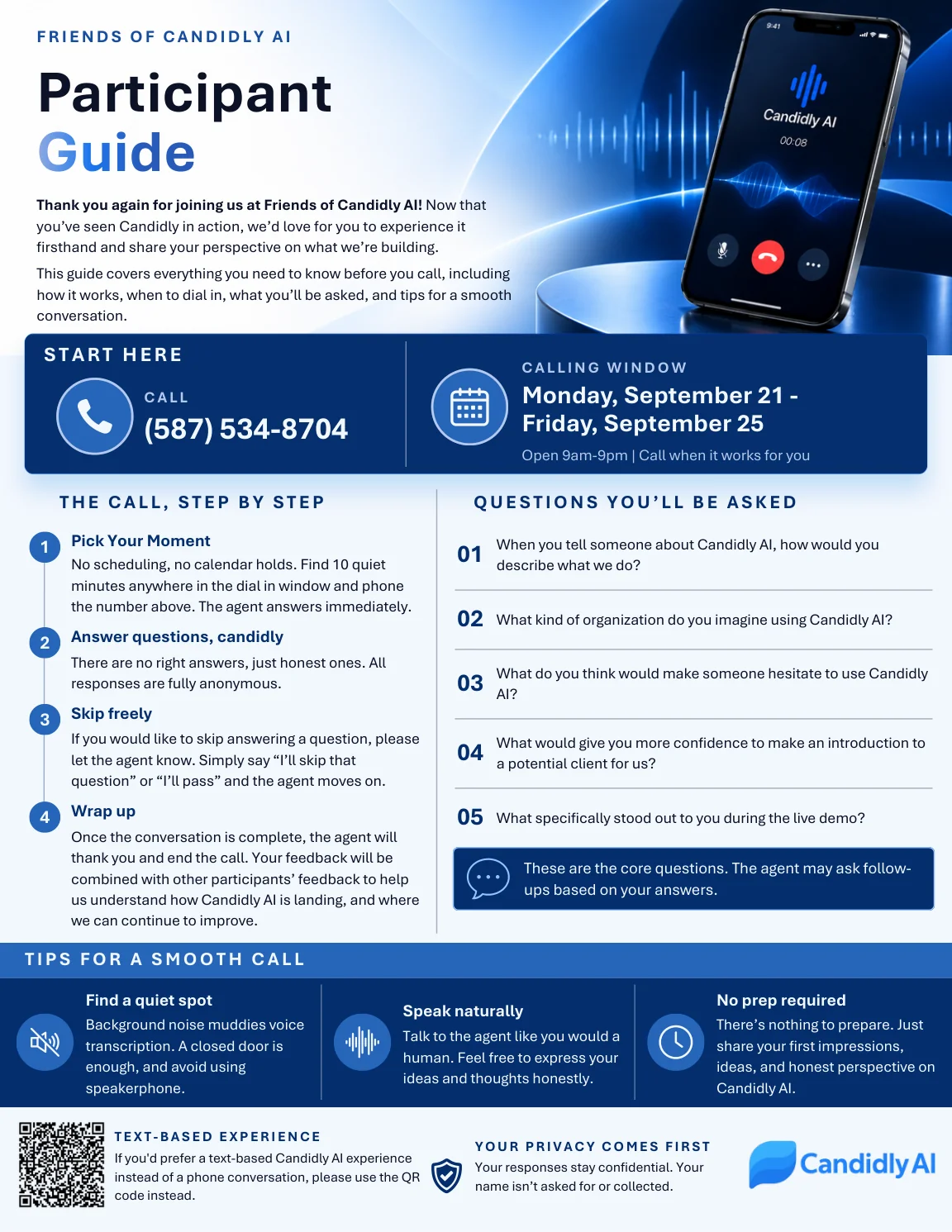
Question 1: How would you describe what we do?
The survey handed us a clarity score of 4.7 out of 5 and eight short answers. "Voice AI for interviews of stakeholders." "Engage stakeholders at scale for intelligent insights." "AI voice agent." Four of the eight led with the technology.
The conversation handed us nineteen descriptions, each a paragraph, each followed by an explanation of why. Callers reached for the same idea in different words: all of your stakeholders, not just a few. A wider audience. Mass interviews that still feel like talking to a person. Nine of nineteen explained the company by comparison with a survey, without being asked.
A 4.7 is a compliment. A paragraph is a position. The room wrote our positioning, in some cases better than we have.
Question 2: Who is it for?
The survey handed us seven categories with checkboxes. Six of nine respondents ticked every one. Municipalities and government scored 9 of 9. The chart is a flat line.
The conversation handed us nine use cases we haven't focused on. Sales pre-screening calls. RFP preparation. User research at a digital agency. Members at a golf club. Restaurant guests. Educators. Real estate buyers. Change readiness before a reorganization. Political polling. Each came from someone picturing Candidly AI inside their own work.
When six of nine people tick every box, the chart is not telling you who the product is for. It is telling you the question was too small. A checkbox can only return what you already wrote down.
Question 3: What stood out from the demo?
The survey handed us 4.7 out of 5.
The conversation handed us seven of nineteen callers naming the same moment: the agent heard an answer and asked the next question. One recalled the exact exchange a week later, the agent asking which part of proposal writing was the frustrating part, and then explained why it matters more than it looks. A junior facilitator collects the answer and moves on. The agent asks which part.
A 4.7 says they liked it. A caller telling you which four seconds landed tells you what to build the next demo around.
Question 4: What would help you introduce us?
The survey handed us "Nothing, I am already confident" as the top answer with four, followed by a three-way tie at three between "Seeing a sample report," "Clear pricing" and "A reference customer."
The conversation handed us six callers ready to make an introduction now and two who already had. Then the specific asks: the exact elevator pitch, a list of talking points, more deployed examples, and a tailored demo link they could forward to a particular prospect so that prospect hears their own use case. One caller described what the client should feel at the end: the Candidly AI team handles the delivery, you just get the results.
"Already confident" is the nicest thing a survey can say to you. It is also the least useful. One of these is a sentiment. The other is the foundation of a GTM campaign.
Question 5: What would make someone hesitate?
The survey handed us privacy and early stage company tied at four, price at three, and a few write-ins.
The conversation handed us the same concerns with the reasoning attached. The privacy concern came alongside callers saying, unprompted, that they had no concern about how the data was handled. The newness concern came with the observation that the older users who try it tend to become its biggest fans.
A ticked box is an objection with the reason torn off. On the phone, objections arrived explained, which is the only form in which a company can answer them.
The number, once
Nine surveys produced 179 words of free text. That fits on one page with room to spare. Nineteen conversations produced 10,055 words from participants, a median of 310 per call, in a median call under six minutes.
What a score cannot do
The survey was not wrong. Roughly the same share of people led with "voice AI" in both groups, and the scores pointed the same direction as the calls. What changed was that the callers explained themselves.
Next year, if that demo score slips from 4.7 to 4.3, the survey will tell us that and nothing else. A drop in a score is a death certificate without an autopsy. A leadership team can act on an explanation. It cannot act on a 4.7.
What nineteen conversations became
The conversations were turned into a findings report: six themes, 49 verbatim quotes, every caller represented, with coverage by section and by caller at the back. It is the document a client receives at the end of an engagement.
Candidly AI gives decision makers the depth of a one-on-one interview at the scale of a survey. Every stakeholder gets a real conversation on their own time, and leadership gets a report it can act on.
You have just read about the difference. The report is the difference.
Design, Listen, Findings. Candidly AI Sovereign runs models on infrastructure we operate in Canada, with no calls to third-party model APIs. SOC 2 Audited. ISO 27001 Certified.
Read the report: In Their Own Words (PDF, opens in a new tab)